A water heater leak doesn’t have to flood a room to create a serious moisture problem.
Some of the more significant mold conditions we encounter aren’t caused by dramatic water losses. They develop slowly, behind walls, appliances, cabinetry and other areas that aren’t routinely visible.
This recent FirstLine Restoration project is a good example.
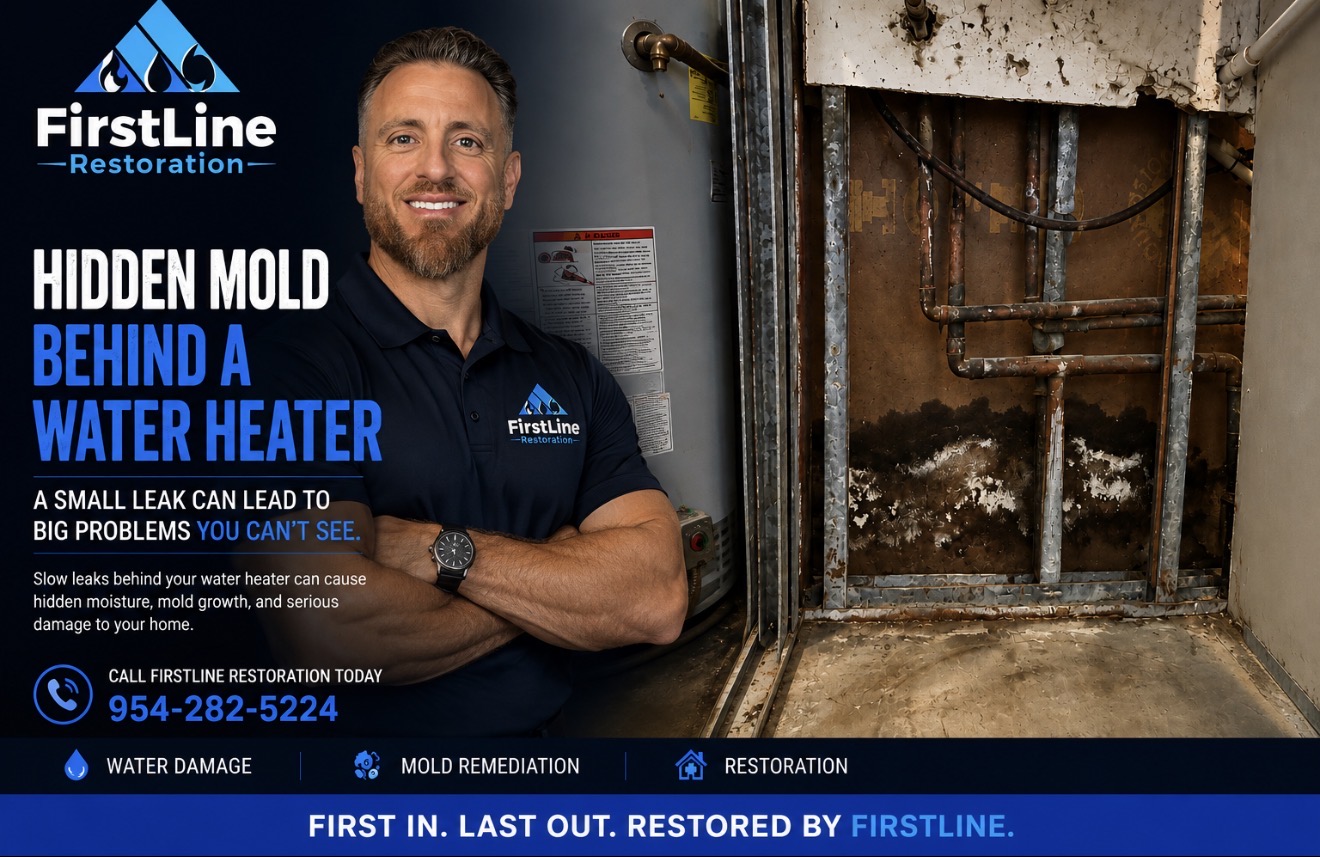
Once the affected area behind the water heater was opened, extensive moisture-related deterioration and suspected microbial growth became visible along the lower portion of the wall assembly. Plumbing, framing and concealed building materials had created an area where a moisture problem could remain largely unnoticed from the occupied side of the space.
It’s a reminder of an important principle in water damage restoration:
What you can see isn’t always the extent of the problem.
For property owners throughout South Florida, recognizing the signs of a concealed water loss early can mean the difference between a relatively contained restoration project and damage extending into multiple building materials.
Why Water Heaters Are Common Locations for Hidden Water Damage
Water heaters are usually installed in utility closets, garages, mechanical rooms or other relatively confined spaces.
That makes them easy to forget about until something goes wrong.
A water heater and its associated plumbing contain several potential sources of moisture, including supply connections, valves, fittings, drain components and the tank itself.
Not every failure produces an obvious flood.
A slow leak can release a relatively small amount of water over an extended period. When that moisture reaches drywall, wood, insulation or other porous materials, deterioration can occur out of sight.
In South Florida’s warm, humid environment, prolonged moisture conditions deserve particular attention.
The Problem With Water You Can’t See
Visible standing water gets attention immediately.
Hidden moisture is different.
Water can migrate behind drywall, underneath flooring, into wall cavities and around framing. Depending on the construction and source of the loss, the visible damage may represent only part of the affected area.
That’s why simply drying the floor in front of a leaking appliance doesn’t necessarily establish that the structure is dry.
A professional water-damage evaluation may include moisture measurements and inspection of adjacent materials to determine how far the water traveled.
FirstLine provides professional water damage restoration and structural drying services for residential and commercial properties throughout South Florida.
What We Found Behind This Water Heater
The photograph from this project shows exactly why concealed areas matter.
After the wall assembly was opened, staining, deterioration and visible suspected microbial growth could be seen along the lower portion of the concealed wall area.
This wasn’t a cosmetic surface issue that could simply be wiped away and painted over.
Once potentially affected materials are discovered inside a wall cavity, the restoration process needs to consider several questions:
- Where did the moisture originate?
- Has the source been corrected?
- Which materials were affected?
- How far did the moisture migrate?
- Are materials still wet?
- What materials can be cleaned or restored?
- What materials require removal?
- Does the affected area extend beyond what is currently exposed?
Those questions should be answered before rebuilding begins.
Mold Is Usually a Moisture Problem First
When people discover mold, their immediate focus understandably becomes removing it.
But mold remediation without addressing the underlying moisture source misses the larger issue.
If the condition that allowed the material to become wet remains, cleaning the visible growth doesn’t solve the problem.
The first objective is therefore to identify and control the moisture source.
That might involve a plumbing repair, water-heater replacement, correction of a building-envelope issue or another appropriate repair depending on the cause.
Only then can the affected building materials be properly addressed.
Why Painting Over Mold Isn’t Remediation
This sounds obvious, but it happens constantly.
A discolored wall gets cleaned, coated with a product and repainted.
The room looks better.
The problem is that surface appearance doesn’t tell us what is happening inside the wall.
If moisture has affected the backside of drywall, insulation, framing or other concealed materials, painting the exposed surface doesn’t address those conditions.
Proper remediation is based on the actual extent and location of affected materials, not simply making the visible surface look clean again.
What Happens During Professional Mold Remediation?
Every project is different, so there isn’t one universal scope that applies to every mold condition.
However, remediation may involve establishing appropriate engineering controls, protecting unaffected areas, removing materials that cannot be adequately restored, cleaning remaining surfaces and managing dust and debris generated during the work.
Containment can be particularly important when demolition will disturb affected materials.
The objective is to perform the work in a controlled manner rather than unnecessarily spreading contaminants into unaffected portions of the property.
The U.S. Environmental Protection Agency provides additional homeowner information about mold and moisture control, emphasizing that controlling moisture is fundamental to controlling mold.
Why Drywall Can Hide Significant Damage
Drywall makes walls look simple.
Behind it can be plumbing, electrical components, insulation, framing and numerous cavities where water can travel.
The backside of drywall can also remain concealed while the painted surface facing the room initially appears relatively normal.
Depending on the source and duration of the moisture, damage may therefore develop before a homeowner realizes anything is wrong.
Possible warning signs include musty odors, staining, bubbling or deteriorating paint, swollen baseboards, soft drywall, recurring moisture near the water heater, corrosion or unexplained discoloration.
None of those conditions alone proves mold is present.
They do justify investigating the source.
Don’t Forget the Materials Below the Wall
Water follows gravity, but building assemblies give it plenty of places to travel.
When evaluating a water loss, the wall isn’t necessarily the only concern.
Depending on the construction, moisture may affect flooring, wall plates, adjacent rooms, cabinetry or other materials.
That is one reason moisture mapping can be useful after a water loss. Rather than assuming damage stops at the visible stain, technicians can evaluate surrounding materials and establish a more defensible drying or remediation scope.
South Florida Humidity Changes the Equation
Our climate makes moisture management particularly important.
Outdoor humidity in Broward, Palm Beach and Miami-Dade counties can remain high for significant portions of the year. Air-conditioning systems and the building envelope are constantly managing differences between indoor and outdoor temperature and humidity.
Introduce an uncontrolled water source into that environment and conditions can change quickly.
The EPA recommends addressing wet or damp materials promptly and correcting the source of moisture as part of mold prevention and cleanup guidance.
EPA Mold and Moisture Guidance
Mold Remediation Is Different From Simply Removing Wet Material
Water mitigation and mold remediation overlap, but they aren’t identical.
A fresh water loss discovered quickly may primarily require extraction, controlled demolition where necessary, drying and monitoring.
A concealed condition that has existed for an unknown period requires a different evaluation.
When suspected microbial growth is present, the project may require additional controls and procedures based on the circumstances and applicable requirements.
Florida also regulates mold-related services. Consumers can review licensing information through the Florida Department of Business and Professional Regulation.
Florida DBPR Mold-Related Services Information
Why Restoration and Reconstruction Should Be Planned Together
Removing damaged material is only half of a restoration project.
Eventually, the property has to be put back together.
Once affected materials have been appropriately addressed and the area is ready for reconstruction, drywall, finishes, trim and other building components may need to be restored.
That transition can become unnecessarily complicated when remediation and reconstruction are treated as completely unrelated projects.
FirstLine Restoration is part of FirstLine Construction Corp., allowing our team to approach a loss from the initial investigation through remediation, drying and eventual reconstruction when required.
Mitigation should have an endgame.
The objective isn’t simply to tear a building apart.
It’s to return the affected area to a safe, dry and functional condition.
Warning Signs Around Your Water Heater You Shouldn’t Ignore
You don’t need to dismantle the wall behind your water heater to look for trouble.
Instead, pay attention to changes around the accessible area.
Look for persistent dampness, staining, corrosion, deterioration at the bottom of surrounding walls, swollen baseboards, damaged drywall or recurring musty odors.
And if the water heater or surrounding plumbing has recently leaked, don’t assume everything is dry simply because the visible water disappeared.
If porous building materials were affected, determining their moisture condition can provide a much clearer picture.
What Should You Do If You Discover Hidden Mold?
First, don’t immediately begin aggressive demolition.
Opening walls and disturbing affected materials without an appropriate plan can spread dust and debris into surrounding areas.
Instead, determine whether the moisture source is still active and have the affected area professionally evaluated.
From there, the appropriate scope can be established based on the actual conditions rather than guesswork.
Hidden Mold Is a Symptom. Finding the Cause Is the Priority.
The lesson from this water-heater project isn’t that every water heater has mold hiding behind it.
Most don’t.
The lesson is that small, concealed water losses can create damage far beyond what is initially visible.
If something smells wrong, looks wrong or continues getting wet, investigate it.
Finding a problem while it’s still confined to a utility area is much better than discovering it after moisture has migrated into adjoining rooms.
Mold Remediation & Water Damage Restoration in South Florida
FirstLine Restoration provides professional water damage mitigation, structural drying, mold remediation and restoration services throughout Broward, Palm Beach and Miami-Dade counties.
Our team investigates the source, determines the extent of affected materials, establishes appropriate controls and develops a restoration plan based on the actual conditions at the property.
FirstLine Restoration
954-282-5224
Florida Mold Remediator MRSR 2865
Florida Mold Assessor MRSA 2655
Certified General Contractor CGC1530039
First in. Last out. Restored by FirstLine.
Leave a Reply