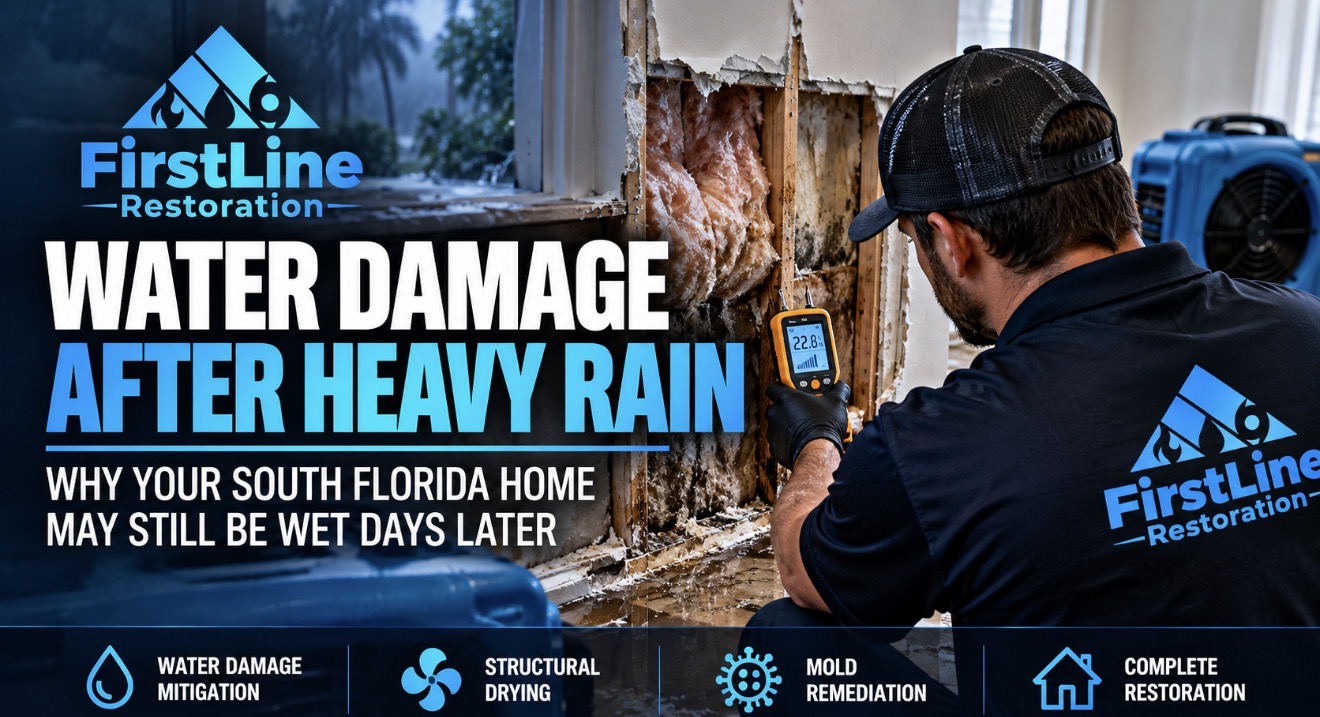
The rain finally stops. The floors look dry. The ceiling isn’t dripping anymore.
Everything must be fine, right?
Not necessarily.
After repeated thunderstorms and prolonged rainfall throughout South Florida, one of the biggest concerns isn’t always the water homeowners can see. It’s the moisture that remains trapped inside building materials after the visible water disappears.
Throughout Coral Springs, Parkland, Tamarac, and surrounding Broward County communities, water intrusion can affect drywall, insulation, flooring, cabinetry, and other concealed areas of a property.
The problem is that many of these materials can retain moisture without showing immediate signs of damage.
At FirstLine Restoration, we understand that successful water damage restoration involves more than removing standing water. It requires identifying the source, evaluating affected materials, establishing appropriate drying procedures, and verifying that the structure has reached its drying goals.
Here’s what South Florida homeowners should understand about hidden moisture after heavy rainfall.
Why Water Damage Can Continue After the Rain Stops
When rainwater enters a building, it doesn’t necessarily remain in one location.
Water can migrate through wall cavities, travel along framing, saturate insulation, and collect beneath certain flooring materials.
Even after the exterior leak stops, moisture can remain trapped within the building assembly.
For example, a roof leak may introduce water into an attic, where it migrates through insulation before reaching the ceiling drywall.
By the time a homeowner notices staining, the moisture may have already affected multiple materials.
The visible stain identifies a symptom.
It doesn’t necessarily identify the full extent of damage.
Five Places Hidden Water Damage Can Develop
1. Behind Drywall
Drywall can absorb moisture, particularly along its lower edges and exposed surfaces.
Depending on the duration and extent of water exposure, moisture may remain within the wall cavity even when the painted surface appears dry.
Baseboards, insulation, and framing can also be affected.
2. Beneath Flooring
Tile, luxury vinyl plank, laminate, hardwood, and other flooring systems respond differently to water exposure.
A tile surface may appear dry while moisture remains within adjacent materials or portions of the flooring assembly.
That doesn’t mean every wet floor requires removal.
It means the materials and underlying conditions should be evaluated before deciding whether drying, cleaning, or removal is necessary.
3. Inside Attic Insulation
Roof leaks frequently introduce water into concealed attic areas.
Insulation can retain moisture, and the extent of damage may not be visible from the occupied space.
A small ceiling stain can therefore warrant inspection of accessible materials above it.
4. Behind Kitchen Cabinets and Built-Ins
Cabinetry can conceal moisture along walls, toe kicks, and adjacent flooring.
Because these areas have limited accessibility, homeowners may not discover damage until staining, swelling, or odors become noticeable.
5. Around Windows and Exterior Wall Openings
Wind-driven rain can expose deficiencies around window assemblies, exterior doors, penetrations, and building-envelope transitions.
Water entering at these locations may migrate into surrounding finishes before becoming visible.
The location of an interior stain does not always identify the precise point where water entered the building.
Why South Florida Humidity Matters
South Florida’s warm, humid environment makes moisture management particularly important.
When building materials become wet, drying depends on several factors, including material composition, temperature, humidity, airflow, and the extent of moisture exposure.
Simply opening windows or placing household fans in a room may not provide adequate drying conditions.
In some circumstances, introducing additional humid outdoor air can make controlling indoor moisture more difficult.
Professional restoration equipment is selected and operated according to the actual conditions.
The objective is to create an appropriate drying environment while monitoring the affected materials.
How Quickly Can Mold Develop After Water Damage?
This is one of the most common questions homeowners ask.
There isn’t a universal timeline that applies to every building or water loss.
Mold growth depends on available moisture, temperature, materials, and other environmental conditions.
However, time matters.
The U.S. Environmental Protection Agency’s guidance on mold and moisture recommends drying wet materials and affected areas within approximately 24 to 48 hours when possible to help prevent mold growth.
That does not mean mold automatically appears after 48 hours.
It means prompt moisture control is important.
If materials have remained wet for an extended period, the restoration approach may need to account for suspected microbial growth and the condition of affected materials.
Why Moisture Mapping Matters
One of the most valuable parts of a professional water damage evaluation is determining where moisture has traveled.
Visible water damage doesn’t always reveal the boundaries of the affected area.
Restoration professionals may use moisture meters, thermal imaging as a screening tool, and other appropriate methods to evaluate building materials.
Thermal imaging can help identify temperature differences that warrant further investigation, but it does not independently prove that moisture is present.
Moisture measurements and physical inspection help establish more reliable findings.
A documented moisture map can assist in determining which materials require further evaluation, drying, or removal.
It also provides a reference for monitoring progress.
Does Every Wet Wall Need to Be Removed?
No.
This is an important distinction.
Not every water-damaged material requires demolition.
The appropriate decision depends on factors such as the water source, contamination, material condition, duration of exposure, accessibility, and whether the material can be adequately dried and restored.
Some materials may be suitable for drying in place under appropriate circumstances.
Others may require removal because they are damaged, contaminated, or cannot be adequately restored.
The EPA’s water damage cleanup and mold prevention guidance provides material-specific considerations, including circumstances in which wallboard may be dried or require replacement.
A properly developed restoration scope should be based on actual conditions rather than assuming that every wet material must be demolished.
What Happens During Professional Structural Drying?
Professional structural drying involves more than placing equipment inside a room.
Depending on the circumstances, the process may include:
- Identifying and addressing the source of water intrusion
- Evaluating the water source and potential contamination
- Documenting affected areas
- Extracting standing water where necessary
- Evaluating materials for restoration or removal
- Establishing appropriate drying conditions
- Installing air-moving and dehumidification equipment
- Monitoring moisture levels and environmental conditions
- Adjusting equipment as drying progresses
- Documenting completion of established drying goals
Not every project requires every procedure.
The drying strategy should reflect the building materials, conditions, and scope of the loss.
Why Household Fans Aren’t Always Enough
Homeowners often respond to water damage by placing fans near affected areas.
For a minor, clean-water spill on an appropriate surface, basic drying measures may sometimes be sufficient.
However, concealed moisture inside wall cavities or beneath flooring presents a different challenge.
Moving air across a visible surface does not establish that moisture trapped behind it has been removed.
Additionally, fans should not be used indiscriminately when contaminated water or suspected microbial growth is present because airflow can disturb and distribute contaminants.
The appropriate drying method depends on the actual loss conditions.
Roof Leaks Can Become Restoration Projects
During extended periods of rainfall, roofing and interior restoration often become closely connected.
A roof leak may initially appear to be an isolated exterior problem.
But once water enters the building, it can affect insulation, ceilings, walls, electrical components, and interior finishes.
Correcting the roof deficiency addresses the source.
Evaluating and drying affected interior materials addresses the resulting damage.
Both may be necessary.
FirstLine Construction Corp. provides roofing services through FirstLine Roofing, including roofing services in Coral Springs and roofing services in Tamarac.
Our combined construction and restoration experience helps us understand how exterior building failures can affect interior assemblies.
What Should You Do If You Discover Water Damage After Heavy Rain?
The first priority is safety.
If water is entering near electrical equipment, outlets, or fixtures, avoid the affected components and obtain qualified assistance.
Do not enter areas with suspected structural instability or ceilings that may collapse.
If safe, document the visible damage and move unaffected belongings away from wet areas.
Avoid disturbing suspected mold growth or opening concealed building assemblies without an appropriate plan.
Arrange for the water source to be evaluated and corrected, and have affected materials assessed promptly.
Waiting for visible staining to become worse isn’t necessary before seeking professional guidance.
Frequently Asked Questions About Hidden Water Damage
Can drywall still be wet if it feels dry?
Yes. Surface appearance and touch do not reliably establish the moisture condition of the entire wall assembly.
Can moisture remain beneath tile flooring?
Yes. Depending on the construction and source of water, moisture can affect materials beneath or adjacent to tile. Proper evaluation is necessary to determine its extent.
Will running my air conditioner dry water-damaged walls?
Air conditioning can help manage indoor humidity, but it is not a substitute for evaluating and appropriately drying saturated building materials.
Does every roof leak cause mold?
No. Mold growth depends on moisture conditions, duration, materials, and other factors. Promptly addressing water intrusion reduces the risk.
How long does structural drying take?
Drying duration varies according to the affected materials, moisture conditions, extent of damage, and drying environment. There is no reliable universal timeframe.
Should I remove wet drywall myself?
Not necessarily. The appropriate action depends on the water source, contamination, material condition, and scope. Unplanned demolition can create additional hazards.
Water Damage Restoration in Coral Springs, Parkland, Tamarac, and South Florida
After days of heavy rainfall, the absence of visible standing water doesn’t necessarily mean your property is dry.
Moisture can remain concealed within building materials long after the rain has stopped.
Identifying the source, determining the extent of affected materials, and establishing appropriate drying procedures can help prevent additional deterioration and unnecessary reconstruction.
FirstLine Restoration provides professional water damage mitigation, structural drying, mold remediation, and restoration services throughout Broward, Palm Beach, and Miami-Dade counties.
We serve residential and commercial property owners in Coral Springs, Parkland, Tamarac, Coconut Creek, Deerfield Beach, Boca Raton, and surrounding South Florida communities.
Whether you’re dealing with a roof leak, plumbing failure, appliance leak, or concealed moisture, our objective is to identify the problem and develop a restoration plan based on the actual conditions.
Concerned about hidden water damage after heavy rain?
Contact FirstLine Restoration to discuss your property and arrange an evaluation.
FirstLine Restoration
954-282-5224
Florida Certified General Contractor: CGC1530039
Florida Mold Remediator: MRSR 2865
First in. Last out. Restored by FirstLine.
Leave a Reply